
Right then, let's talk numbers. When people ask, "How much do Instagram ads cost?", they're usually hoping for a simple answer. The reality is a bit more 'how long is a piece of string?'.
That said, a good ballpark figure to start with in Australia is somewhere between $0.50 to $1.00 per click (CPC). If you're paying for eyeballs instead of actions, you're looking at around $5.00 to $6.00 per 1,000 impressions (CPM).
Think of these numbers as your starting point, not the final price tag. Your actual costs will dance around depending on who you're trying to reach, how fierce the competition is, and what you're trying to achieve with your campaign.
Before you can really nail your Instagram advertising, you need a clear financial baseline. It’s like planning a road trip across Australia; you wouldn't just jump in the car without a rough idea of how much you'll need for fuel. These initial numbers give you a destination, but understanding the metrics behind them is what provides the map.
Setting a realistic budget really boils down to knowing the two main ways you'll be charged:
These benchmarks are just that—benchmarks. The real cost you'll see is dynamic, constantly shifting based on things like ad quality, how specific your targeting is, and how many other businesses are chasing the same audience. Costs will naturally creep up during busy periods like Christmas or Black Friday when the ad space gets more crowded.
To give you a clearer picture, here’s a simple table breaking down what you can generally expect to invest when advertising on Instagram in the Aussie market. Just remember, these are averages, and your own results will definitely vary.
| Ad Cost Model | What It Means | Average Cost Range (AUD) |
|---|---|---|
| Cost Per Click (CPC) | Payment for each individual click on your ad. | $0.50 – $1.00 |
| Cost Per 1,000 Impressions (CPM) | Payment for every thousand times your ad is displayed. | $5.00 – $6.00 |
The infographic below really helps visualise how these two core metrics, CPC and CPM, directly shape your overall budget.
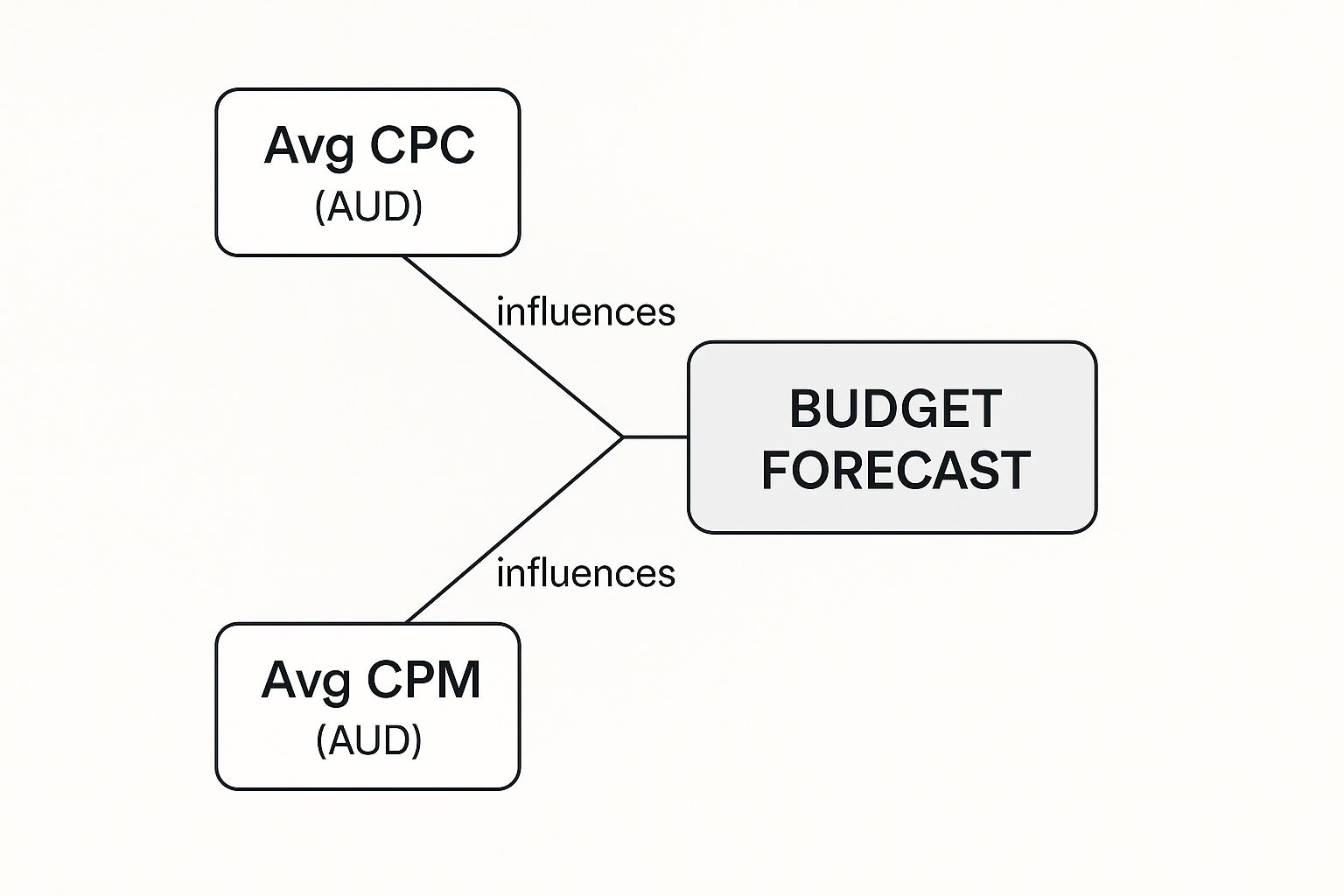
Ultimately, your campaign objective dictates which metric you should focus on, and that choice becomes the financial bedrock of your entire strategy.
It's also worth remembering that Instagram ads are run through the Meta Ads platform, which means a lot of the same cost principles from Facebook apply. For a bit more context, you might want to check out our guide on the average cost of Facebook ads.
You'll quickly see that while the platforms are joined at the hip, their advertising costs have unique quirks that can definitely impact your budget.

To really get a handle on your Instagram ad costs, you need to peek behind the curtain and understand the system that sets the price. Every time there’s a spot to show an ad to a user, Instagram runs a lightning-fast auction to decide which one gets the real estate.
But here’s the most important thing to realise: this isn't your typical auction where the highest bidder always wins. A big budget certainly helps, but it absolutely doesn't guarantee you the top spot.
Think of it more like an auction for a unique piece of art. The auctioneer isn't just looking at who's throwing the most money around. They’re also considering which bidder genuinely appreciates the art and has a great reputation. In the same way, Instagram’s algorithm wants to show its users ads they’ll actually find interesting and relevant.
This means a smaller business with a highly engaging, well-targeted ad can often beat a competitor with a much larger budget. The winner isn't the ad with the biggest wallet; it's the ad that creates the most overall value.
So, how does Instagram figure out this "total value"? It boils down to three core ingredients. Getting a grip on these is the secret to managing your Instagram ad costs and getting better results for every dollar you spend.
The formula looks a little something like this:
Let's break down exactly what each of these means for your campaigns and, more importantly, your budget.
Your bid is the most direct financial lever you can pull. You're telling Instagram the maximum you’re willing to pay for a specific outcome. Think of this as setting your maximum offer at that art auction we mentioned.
The key thing to remember is that you often won't pay your full bid. You only need to pay just enough to outbid the next competitor in that specific auction. So, a higher bid makes you more competitive, but it doesn't automatically mean you'll spend more.
Next up is the estimated action rate. Using its massive amount of data, Instagram predicts the probability that showing your ad to a specific person will lead to the result you want.
The platform is constantly asking itself questions like, "If we show this ad to Sarah, who loves boutique fashion, what are the chances she'll actually click through to this online clothing store?" A higher probability means your ad is more likely to win the auction, even if your bid is a bit lower than a competitor's.
This prediction is based on everything from the user's past behaviour and your ad's performance right through to the historical performance of your entire ad account. It's Instagram's way of making sure it shows ads that people are likely to engage with, which creates a better experience for everyone on the platform.
Finally, we have ad quality. This is your secret weapon for driving down your Instagram ad costs. Put simply, this is Instagram’s assessment of how good your creative actually is.
It looks at factors like:
A high-quality, engaging ad gets positive feedback, which signals to the algorithm that it’s a great fit for users. This boosts your total value score in the auction, helping you win more placements at a lower cost. It’s how you outsmart competitors who are just trying to spend their way to the top.
Ever wondered why one business pays $0.60 per click while their direct competitor is stuck paying over $2.20 for the same audience? It’s a common question, and the answer isn't just about who has the bigger budget. Several critical, interconnected factors control your final Instagram ad cost.
Think of it like the levers on a sound mixing board. Adjusting one changes the entire output. Mastering these levers is the key to fine-tuning your campaigns, turning a potentially runaway expense into a predictable, profitable investment. Let's break down the variables that directly control how much you pay.
First and foremost, who are you trying to reach? This is the most significant factor. The more specific and in-demand your audience is, the more you'll pay to get your ad in front of them. It's a classic case of supply and demand playing out in the ad auction.
Imagine you're targeting 'newly engaged couples in Melbourne'. This is an incredibly valuable, niche audience that countless businesses—from wedding photographers to venues and florists—are all competing for. That intense competition drives the price up.
On the other hand, an audience like 'fitness enthusiasts across Australia' is much broader. While still valuable, the sheer size of this group means there's less direct, head-to-head competition for any single user, which usually means a lower cost per action.
Key Takeaway: A highly defined audience often delivers better results, but it comes at a premium. The real challenge is finding that sweet spot between audience specificity and cost-effectiveness, which is a core part of optimising your digital marketing performance metrics.
Where your ad actually appears on Instagram also plays a massive role in what it costs. Not all placements are created equal; some are more coveted (and therefore more expensive) than others.
Here’s a look at the placement selection screen inside the Meta Ads Manager.
This interface gives you direct control over this cost factor, allowing you to manually choose where your ads show up.
The time of year dramatically impacts your Instagram ad costs. During peak shopping seasons, the ad auction becomes a much more crowded and competitive place. It's like trying to book a hotel during school holidays – prices just go up.
You can expect costs to surge during key periods like:
Planning your campaigns around these periods is crucial. If your product isn't seasonal, you might find it more cost-effective to pull back your ad spend during these peak times and reallocate it to quieter months.
Finally, your industry has a massive influence. Highly competitive sectors like fashion, beauty, and e-commerce generally face higher advertising costs because thousands of brands are all fighting for the same eyeballs. Doing a proper competitive landscape analysis is a smart move to understand the dynamics you're up against in the ad auction.
The Australian market for social media advertising is growing fast, which makes this an even more important consideration. With Instagram being such a vital platform for businesses, a strategic approach to your spending is essential to stay ahead of the pack.
To put it all together, here’s a simple table showing how these choices can push your costs up or down.
| Influencing Factor | High-Cost Scenario | Low-Cost Scenario |
|---|---|---|
| Target Audience | A very specific, high-value niche (e.g., CEOs in Sydney) | A broad, general interest group (e.g., dog lovers Australia-wide) |
| Ad Placement | Highly competitive Instagram Feed placement | Less saturated placements like Reels or Audience Network |
| Seasonality | Advertising during the Black Friday/Christmas peak | Running campaigns during a quieter period like February or July |
| Competition | Operating in a crowded market like fast fashion or beauty | Serving a less competitive B2B or specialised industry |
Understanding these dynamics is the first step. The goal isn't just to find the cheapest option, but to find the most valuable one that delivers the best return for your business.
Before you even start dreaming up clever ad copy or eye-catching visuals, you’ll make the single most important decision for your Instagram campaign: choosing your objective. This is where you tell Instagram’s algorithm exactly what a ‘win’ looks like for you. Get this right, and it will directly influence how your budget is spent and, ultimately, your final Instagram ad cost.
Think of it like planning a road trip. Your destination (the objective) dictates the best way to travel (the pricing model). If your goal is just to have as many people as possible see your brand, you’d hop on a tour bus. You’d pay based on how many people get a look at the sights—this is your Cost Per 1,000 Impressions (CPM).
But what if you need to get people to a specific place, like your website? A taxi is a better fit. You wouldn't pay for how many people saw your taxi driving by; you'd pay only when someone actually gets dropped off at the front door. That’s your Cost Per Click (CPC).
Lining up your goal with the right model is the first, and most crucial, step in controlling your ad spend.
The good news is that Instagram makes this fairly straightforward by linking certain objectives to the most logical pricing outcomes. When you choose an objective at the start of a campaign, you're not just picking a fancy label; you're giving the algorithm its marching orders.
Here’s a quick rundown of how common objectives connect to the way you’ll pay:
Choosing ‘Conversions’ when all you really want is brand visibility is like hiring a fleet of limousines to hand out flyers. It’s an expensive, inefficient way to get the job done.
Once you’ve set your objective, you need to decide how you want to bid in the ad auction. This is your chance to give Instagram some instructions on how to handle your money. You can either let the algorithm take the wheel completely or set a few ground rules.
Think of it like telling a driver how to get you to your destination. Do you want the absolute fastest route, no matter the cost of tolls (Lowest Cost)? Or do you have a strict budget you need to stick to, even if the trip takes a little longer (Cost Cap)?
Let’s break down the two main strategies.
This is the default setting and by far the simplest option. With Lowest Cost, you’re telling Instagram to get you the most results it can within your budget. The algorithm has complete freedom to bid as high or as low as it needs to win auctions and deliver your desired action.
A Cost Cap strategy puts you more in the driver's seat. You set an average cost you’re willing to pay for each result. Instagram will then do its best to keep your average cost at or below that number over the life of the campaign.
At the end of the day, your objective sets the destination, and your bidding strategy is the roadmap. Getting this combination right is the key to turning your ad spend into a genuine investment, not just another business expense.
Knowing what influences your Instagram ad cost is one thing, but actively managing and improving it is where strategy turns into real results. The goal isn't just to spend money; it's to invest it wisely, making sure every dollar works as hard as possible to grow your business. This means smart budgeting, careful testing, and never-ending optimisation.
Think of your ad budget like the fuel for a high-performance engine. You don't just pour it all in at once and hope for the best. You start with a small amount to warm the engine up, listen to how it runs, make adjustments, and only add more fuel when you're confident it'll translate into pure speed. A disciplined approach like this prevents waste and builds a foundation for profitable campaigns you can actually scale.
Jumping in with a massive budget from day one is a recipe for disaster. The smartest way to begin is with a small, controlled test budget. This initial phase isn't about chasing huge sales numbers; it's about gathering crucial data.
Your goal here is simple: understand your baseline metrics. How much does a click typically cost for your audience? What's your starting Click-Through Rate (CTR)? This data is your compass, telling you what's working and what isn’t before you commit serious funds. A modest daily budget of $20 to $50 is often more than enough to start collecting this invaluable information.
Once you have this data, you can make decisions based on facts, not guesswork. You'll know what a "good" CTR looks like for your ads and your audience, giving you a benchmark for every optimisation effort that follows.
One of the most powerful tools in your optimisation kit is A/B testing, sometimes called split testing. It’s a straightforward process: run two slightly different versions of an ad at the same time to see which one performs better. It’s the scientific way to stop guessing and start knowing.
You can test almost any part of your ad, but the golden rule is to only change one variable at a time. That's the only way you'll know for sure what caused the change in performance.
By constantly testing, you refine your campaigns based on real user behaviour, which almost always drives down your Instagram ad cost over time.
To stretch your budget even further, you should seriously consider using Meta's Campaign Budget Optimisation (CBO) feature. When you turn CBO on, you set a single, central budget at the campaign level, and Meta’s algorithm automatically distributes it across your different ad sets in real-time.
This is a fantastic, hands-off way to optimise. The algorithm is smart; it identifies which ad sets (your audiences) are delivering the best results for the lowest cost and pushes more of your budget towards them. It essentially does the heavy lifting of budget management for you, ensuring your money is always flowing to the top performers in your campaign.
Here’s a look at where you would turn on Campaign Budget Optimisation (which Meta now calls Advantage Campaign Budget) in the Ads Manager.
By flicking this switch, you empower the algorithm to make data-driven decisions on your behalf, often leading to a much more efficient use of your total ad spend.
Beyond the traditional ads auction, it's worth thinking about influencer marketing as part of your overall strategy. Collaborating with Australian influencers can sometimes offer a more predictable cost for reaching hyper-engaged, niche audiences.
For brands looking to build trust and social proof, this can be a hugely effective alternative to the fluctuating costs of the ad auction. For example, nano-influencers in Australia might charge anywhere from AU $3.03 to AU $393.09 per post, offering a very accessible entry point.
Once you’ve mastered these foundational tactics, you might be ready to expand your reach. You can explore strategies on how to scale Facebook Ads effectively without burning through your budget, as many of these principles apply directly to Instagram. And for those who want expert guidance to get there faster, partnering with an experienced Instagram ads agency can help refine your strategy and accelerate your results.
Alright, let's get down to the brass tacks. When you're managing your own Instagram ad spend, a few key questions always seem to pop up. Think of this as your go-to cheat sheet for the common queries we hear from Australian businesses, designed to help you get your budget sorted with a bit more confidence.
This is the million-dollar question, but the answer isn't a single magic number. What's "good" really depends on your industry, who you're targeting, and what you're trying to achieve. That said, a solid benchmark for many Aussie businesses is to aim for anything under $1.00.
If you're in a less crowded market, you might even see your Cost Per Click (CPC) dip as low as $0.50. But if you're in a fiercely competitive space like fashion or finance, where you're bidding for high-value customers, a "good" CPC could be closer to $2.00. The real test of a good CPC is simple: is it profitable? If your cost per click is delivering a positive return on ad spend (ROAS), then it's a great CPC for your business.
You don't need a huge war chest to get going. In fact, it's much smarter to start small, test the waters, and let the data tell you where to go next. For most small businesses in Australia, a daily budget of $20 to $50 is the perfect starting point.
This initial spend isn't about making a mountain of sales right away—it's about learning. It gives you just enough runway to collect vital intel on your CPC, Click-Through Rate (CTR), and how your audience is responding. Once you figure out what's resonating, you can start scaling up your budget knowing you're putting money behind a proven strategy, not just taking a shot in the dark.
It’s always a bit of a shock when your costs suddenly spike, but there's usually a logical explanation. Most often, the culprit is more competition in the ad auction.
Think of it like this: if a massive sales event like Black Friday is on the horizon, or it’s the Christmas rush, heaps of other advertisers are jumping in to fight for the same eyeballs. This surge in demand for ad space naturally drives up the price for everyone.
A few other things could be at play, too:
Keeping a close eye on your ad frequency and regularly refreshing your creative is the best way to keep these sudden jumps in your Instagram ad cost under control.
Ready to stop guessing and start getting real, measurable results from your advertising? The team at Virtual Ad Agency are experts in optimising the entire customer journey, making sure every dollar you spend is working as hard as it can. Learn more about how we can help you grow.

 previous