
Before you even dream of a logo or snatch up that perfect domain name, the real work begins. Launching a successful online business isn't about the flashy stuff first; it's about laying a rock-solid foundation through meticulous planning and validation. This is where you figure out if your brilliant idea has a genuine place in the market.

The opportunity, especially here in Australia, is massive. The local e-commerce scene is absolutely booming. Aussies spent around AU$69 billion online in a recent year, which was a 12% jump from the year before. Think about that. Online shopping now makes up nearly 17% of all retail spending—a huge leap from before the pandemic, proving that Aussie consumers have firmly shifted their buying habits online.
So, where do you start? You find your niche. This isn't just about picking a product; it’s about identifying a specific corner of a bigger market that you can serve better than anyone else. Instead of trying to sell "clothing," you might zero in on "sustainable corporate wear for women." Getting specific like this helps you cut through the noise and connect with a passionate, ready-made audience.
To see if your idea has legs, try these practical steps:
A niche isn't just a small market; it's a focused one where you can become the go-to expert. If you want a full rundown, this ultimate guide on how to start an e-commerce company covers all the essentials.
Once you've carved out your niche, you need to figure out what makes you different. This is your Unique Selling Proposition (USP)—the one thing that sets you apart from every other player in the game. It's the simple answer to the question, "Why should I buy from you and not them?"
Your USP could be built on a few different things:
A strong USP is so much more than a catchy slogan; it's the core promise you make to your customers. It needs to be clear, concise, and woven into everything you do, from your website copy to your marketing campaigns.
A huge part of this process is sizing up the competition. You need to know their game inside and out to find the gaps they've left open for you. To get started, have a look at our guide on how to conduct a thorough competitor analysis for some practical strategies. By really understanding their strengths and weaknesses, you can carve out a unique space for your own venture.
So, you’ve got a killer idea and you’re confident it has legs. Fantastic. Now comes the part that feels a bit less exciting but is absolutely critical: making it official.
Getting your legal and financial foundations right from day one isn't just about ticking boxes for the government. It’s about protecting yourself, your assets, and setting your new venture up for clean, manageable growth. For anyone starting an online business in Australia, this step is non-negotiable.
Your first big decision is how to structure your business. This choice dictates everything from your tax obligations and personal liability to the amount of paperwork you'll be wrestling with. It's a foundational move that ripples through your entire business journey.
In Australia, you'll likely be looking at three main options: sole trader, partnership, or company. Each has its own rules, perks, and pitfalls.
A sole trader setup is the simplest. The business is legally tied directly to you, meaning you’re personally on the hook for any debts. A partnership is for two or more people who agree to distribute income and losses between them. Finally, a proprietary limited (Pty Ltd) company is a separate legal entity. This structure offers the best protection for your personal assets but comes with higher setup costs and more complex reporting requirements.
This chart breaks down the key differences to help you see where you might fit.
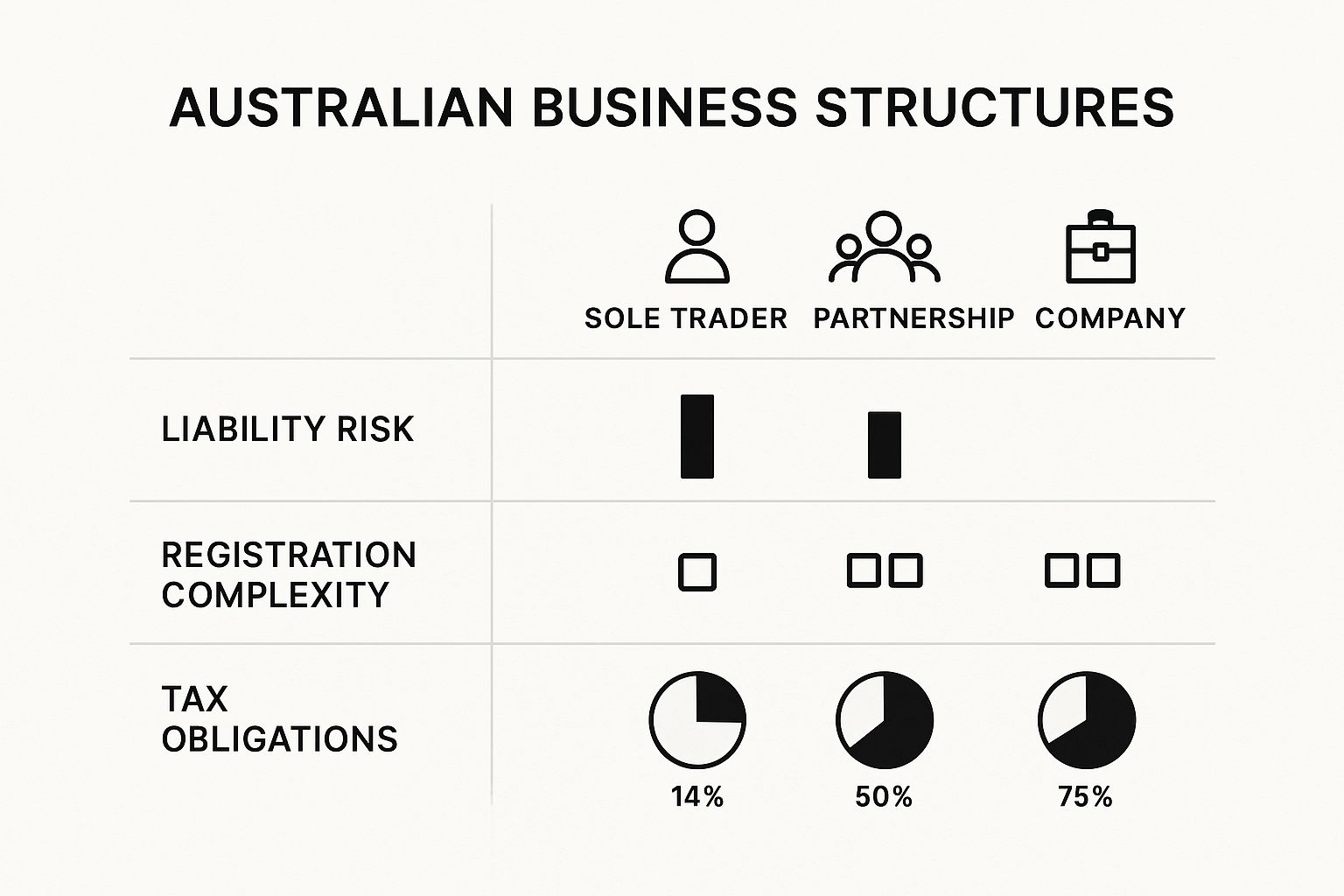
As you can see, there’s a clear trade-off. As you move from a sole trader to a company, your personal liability drops, but the admin complexity and costs ramp up significantly.
Once you’ve picked a structure, it’s time to register. No matter which path you take, you’ll need an Australian Business Number (ABN). This unique 11-digit number is your business's fingerprint for all official activities—invoicing, claiming tax credits, and dealing with other businesses. Applying for one is free through the Australian Business Register (ABR).
Planning to trade under a catchy name that isn’t your own? If you're a sole trader or partnership, you’ll need to register that business name with the Australian Securities and Investments Commission (ASIC).
Important Takeaway: Think of it like this: your ABN identifies you to the government for tax, while your registered business name is the brand your customers see. They are two separate but equally vital registrations.
Tax is the next big piece of the puzzle. A common trip-up for new entrepreneurs is the Goods and Services Tax (GST). Here’s the deal: you are only required to register for GST once your business turnover hits (or is expected to hit) $75,000 in a 12-month period.
Many new online businesses start out without being registered for GST, and that’s perfectly fine. The key is to keep a close eye on your revenue. The moment you cross that $75,000 threshold, registration becomes compulsory. You'll then need to start collecting GST on your sales and lodging Business Activity Statements (BAS) with the Australian Taxation Office (ATO).
Here’s one of the best habits you can form right now: keep your business and personal finances separate. As soon as you have your ABN, open a dedicated business bank account.
This simple act makes bookkeeping, tax time, and tracking your business’s financial health immeasurably easier. It creates a clear boundary between your money and the business's money, which is vital for accurate reporting and legal protection—especially if you've registered as a company.
Of course, there’s also the matter of funding. While many online businesses are bootstrapped (self-funded), you might also look into:
Sorting out these legal and financial nuts and bolts provides the solid ground you need to build and scale your online business with confidence. It might feel like admin, but it’s actually your launchpad.
With the legal paperwork sorted, it’s time for the fun part: building your digital home. Don't fall into the trap of thinking your website is just a catalogue. It's your number one salesperson, your brand's entire personality, and your customer service desk all rolled into one.
Choosing the right platform is easily one of the most critical decisions you'll make. It dictates everything from how you list products to how you take payments, so it’s not something to rush. Your budget, how tech-savvy you are, and where you see your business in a few years will all steer you toward the right choice.
For most Aussie businesses just starting out, the conversation usually boils down to three main players: Shopify, WooCommerce, and BigCommerce. Each one strikes a different balance between ease of use, creative control, and raw power. Before you jump in, it pays to do a thorough e-commerce platform comparison to see which one genuinely fits what you’re trying to build.
Let’s look at where each one really shines:
Shopify: This is the crowd favourite for beginners, and for good reason. If you want an all-in-one solution that just works out of the box without you having to fuss over hosting or security, Shopify is brilliant. Its app store is also a massive plus, making it dead simple to add new features as you grow.
WooCommerce: Got a WordPress site already? Or maybe you just want total control over every pixel and line of code. If that’s you, WooCommerce is the way to go. It’s a free plugin, but you’ll be on the hook for your own web hosting and security. It offers limitless customisation, but it definitely requires a bit more technical comfort.
BigCommerce: Think of this as a powerful hybrid. It gives you the hosted convenience of Shopify but comes loaded with advanced features built-in that you’d normally pay extra for. It’s a seriously strong contender for businesses that plan to scale fast or want to sell across multiple marketplaces right from the start.
Your platform is your business's central nervous system. Consider not just where you are today, but where you want to be in two years. Migrating an established store is a significant undertaking, so choosing wisely now will save you major headaches later.
If your current website is holding you back, it might be time for a fresh start. A professional website redesign in Australia can get you onto a platform that’s actually built to support your growth, not hinder it.
To make things a bit clearer, here's a quick table breaking down what matters most for a new Australian online business.
| Platform | Best For | Monthly Price (AUD) | Key Features |
|---|---|---|---|
| Shopify | Beginners and businesses wanting an all-in-one, easy-to-use solution. | Starts at ~$45 | Huge app store, integrated payment gateway, excellent support. |
| WooCommerce | Businesses with existing WordPress sites or those needing full customisation. | Free (hosting costs extra) | Open-source, endless flexibility, large developer community. |
| BigCommerce | Ambitious start-ups and businesses planning to sell across multiple channels. | Starts at ~$50 | No transaction fees, advanced built-in features for SEO and marketing. |
Ultimately, the "best" platform is the one that fits your specific business model, technical skills, and budget.
Your domain name is your address on the internet—make it memorable, brandable, and easy for people to type. Grabbing a .com.au or .au extension is a no-brainer for building trust with local customers.
Once you have the name, you need hosting—the patch of digital land where your site will live.
If you go with a platform like Shopify or BigCommerce, reliable hosting is already baked into your monthly subscription. For WooCommerce users, you'll need to sort this out yourself with a provider like SiteGround or Cloudways. Don't skimp here; look for fast servers and great support. After all, 40% of people will leave a website that takes more than three seconds to load.
Beyond your main platform, you’ll need a few other tools to keep things running smoothly. This collection of software is your "tech stack," and a good one makes your life infinitely easier.
For starters, you'll want tools to handle:
Building your tech stack is a marathon, not a sprint. Start with these essentials and only add new tools when you have a clear problem to solve. The goal is for technology to serve your business, not the other way around.

You’ve built your digital storefront and your product line-up is looking sharp. Now for the hard part: getting people to actually show up. An incredible online business with no marketing plan is basically a shop with no front door.
Good marketing isn't about just making noise online; it's about making smart connections with the right people, in the right places. That means building a savvy, budget-friendly strategy to bring in that first crucial wave of traffic and sales.
For anyone launching an online business in Australia, the audience is already there. The country boasts 26.1 million internet users, which is a massive 97.1% of the population. This incredible online saturation is a gift for new digital ventures, and that figure is set to climb to 27.7 million by 2029. You can dive deeper into the stats on the Australian digital landscape over at DataReportal.
Search Engine Optimisation (SEO) is your long game. It's how you attract customers who are already looking for what you offer. When someone types "ethically sourced coffee beans Melbourne" into Google, SEO is what gets your website to pop up.
Getting started doesn't have to be a massive headache. Just focus on the basics:
Think of SEO as a marathon, not a sprint. The groundwork you lay down today will pay off with organic, "free" traffic for months and even years down the track.
Content marketing is all about creating and sharing genuinely useful information to pull in your target audience. This isn't a hard sell; it’s about positioning your business as a trusted voice in your space.
A blog is often the heart of a solid content strategy. For instance, if you're selling high-end kitchenware, you could create articles like:
This kind of content solves problems, builds trust, and gives you a natural way to talk about your products. It also gives you fantastic material to share across your social media channels and in email newsletters, fuelling your whole marketing machine.
Key Takeaway: The goal with content is to educate and inspire, not just to sell. When you consistently deliver value, customers will naturally turn to your brand when they're ready to buy.
Social media is where your brand gets a personality. It's your chance to build real relationships with customers. The trick is to choose your platforms wisely. Don't spread yourself thin trying to be everywhere; just focus on where your target audience actually hangs out.
If you sell visually stunning products like fashion or homewares, Instagram and Pinterest are your best mates. If your customers are more business-minded, LinkedIn might be a smarter bet.
Once you're set up, concentrate on creating a community. That means:
Authenticity is everything on social media. People connect with real stories and genuine interaction, not corporate jargon and an endless stream of promos.
Don't sleep on email marketing. It's still one of the most powerful tools out there, giving you a direct line to your most interested followers. Unlike social media, you own your email list—it's not at the mercy of some algorithm change.
Start building that list from day one. Offer a compelling reason for people to sign up, like a discount on their first purchase, a free guide, or early access to new products.
Your first few email campaigns should be all about nurturing those new subscribers:
By combining solid SEO, value-packed content, genuine social media engagement, and smart email marketing, you build a powerful system that doesn't just find new customers—it turns them into loyal fans.
Getting your online business live is a massive moment, but it's really just the starting pistol for the real race. Now, your focus has to shift from building the thing to actually running it. How you manage the day-to-day is what separates a flash in the pan from a business that lasts.
This is where the rubber meets the road. You’ll be fine-tuning how you get products into your customers' hands and creating experiences that make them want to come back. Smooth operations are the engine room of your business; they might not be the most glamorous part, but without them, everything grinds to a halt.
Order fulfilment is your first real point of physical contact with a customer. Nail this, and you'll make a great impression that lasts long after they've clicked "buy."
In the early days, you can keep it simple. A lot of founders start by packing orders from their living room. This hands-on approach is fantastic for understanding the whole process from the ground up, but let's be honest—it's not going to work forever. As orders pick up, you need a system.
Here are a few practical pointers to get you started:
A slick fulfilment process doesn't just cut down on errors and speed up delivery; it directly fuels customer satisfaction.
In the online world, your customer service is your storefront. A quick, helpful, and human response can turn a slightly annoyed customer into one of your biggest fans.
It’s vital to make it dead simple for people to get in touch. That means a clear contact page with an email address, a contact form, and maybe even a live chat option for business hours.
The key is to be responsive and human. An automated reply can acknowledge a query, but it’s the personal follow-up that genuinely solves a problem that builds real trust and earns those five-star reviews.
Great service also creates a powerful feedback loop. Keep an eye out for recurring questions or complaints. They often point directly to parts of your website, product descriptions, or the overall customer journey that you can improve.
You can't improve what you don't measure. It’s easy to get obsessed with website traffic, but a handful of key performance indicators (KPIs) will give you a much clearer picture of your business's health.
Zero in on these core metrics:
Tools like Google Analytics are non-negotiable for tracking these numbers. Setting up a simple dashboard to watch your KPIs will help you make decisions based on data, not guesswork. And remember, strong customer retention strategies are fundamental to improving your CLV.
Scaling your online business should be a deliberate, calculated process, not a chaotic scramble to keep up. Once you've got your core operations running like a well-oiled machine, you can start looking at ways to expand. Smart growth is all about using what you've learned to make your next move.
When you're planning to scale, it helps to know who's spending money online. The profile of Australian online shoppers is incredibly diverse. Millennials are the biggest spenders at US$14.8 billion, but Gen X and Baby Boomers aren't far behind, spending US$11.7 billion and US$8.3 billion respectively. Even the emerging Gen Z market is throwing down a significant US$7.1 billion. These figures from CMI really drive home how important it is to know your audience as you expand.
Your growth strategies might include things like:
Scaling isn't just about getting bigger; it's about getting better. By mastering your daily operations and listening closely to your data and your customers, you’ll build a resilient foundation for the long haul.
Jumping into the world of e-commerce is exciting, but it’s completely normal to feel like you’re staring at a huge list of questions. From planning to launch, you’re bound to hit a few roadblocks or moments of doubt.
To help clear the fog, we’ve put together some straightforward answers to the questions we hear most often from new entrepreneurs here in Australia.
This is the big one, isn’t it? But thankfully, the answer isn’t as scary as you might think. The truth is, the cost can swing wildly from a few hundred dollars for a super lean setup to thousands if you’re going all in. It all comes down to your business model.
At the bare minimum, you’re looking at a few essential costs:
For a small e-commerce store with a bit of starting inventory and a small marketing budget to get the word out, a more realistic figure is somewhere between AU$1,000 and AU$5,000. That budget climbs, of course, if you’re looking at custom web development, buying a warehouse full of stock, or launching a massive marketing campaign from day one.
This is a really common point of confusion, but the rule itself is pretty clear-cut. In Australia, you only have to register for the Goods and Services Tax (GST) once your business has a GST turnover of AU$75,000 or more in a year.
Plenty of small online businesses start out without being registered for GST, and that’s perfectly fine. It actually keeps your bookkeeping simpler in those crucial early days. The trick is to keep a close eye on your revenue. As you get close to that $75,000 threshold, you’ll need to get registered and start adding GST to your prices.
When you’re just getting started, your best friend is simplicity. For most new online stores, kicking things off with Australia Post is the most practical and reliable way to go. They’re everywhere and offer a whole menu of services for different parcel sizes and delivery times, which means you can get your products out the door without getting tangled in complex contracts.
Once your order volume starts to pick up, you can begin to explore other options. Services like Sendle often have really competitive rates, especially for smaller packages. Down the track, you might even graduate to an integrated shipping platform like Shippit. These tools plug directly into your e-commerce store, automate the boring stuff like printing labels, and give you a central dashboard to manage the whole fulfilment process.
Your first shipping strategy should be all about reliability and ease. Get that right, then as you scale, you can pivot to focus on cutting costs and boosting efficiency. The perfect solution today probably won’t be the right one in a year, so be ready to adapt.
Absolutely! In fact, it’s how the vast majority of online businesses begin. Running your operation from a home base is a brilliant way to keep your overheads rock bottom while you’re finding your feet.
That said, it’s always a good idea to check in with your local council about any specific rules for home-based businesses. These can vary, especially if you plan on holding a lot of stock, having couriers coming and going all day, or if there’s any chance of customers showing up at your door. It’s also smart to have a quick chat with your insurance provider to make sure your home and contents policy covers your business stock and equipment.
At Virtual Ad Agency, we specialise in crafting marketing strategies that help new online businesses make a name for themselves. If you’re ready to build a marketing plan that delivers real, measurable growth, let's talk.

 previous